
Lest We Forget – Anzac Day 2026
posted by Navigators on April 24th, 2026 in Blog | Culture | Jesus
By Grant Dibden, Anglican Bishop to the Australian Defence Force and Chair of the Australian Navigators Board of Directors.
You can learn a lot about a country from the people or events they celebrate in their monuments. In the USA, there’s a great bronzed statue of Abraham Lincoln sitting in his mighty marble temple in Washington. Down the street is a thirty-foot statue of Thomas Jefferson. In Paris, you see Napoleon. Throughout London and the rest of the country are the monuments of Wellington and Nelson.
But, in Australia, the monument that pervades our nation is the cenotaph. It’s central to every Australian country town as well as many scattered through our cities. Millions of Australians will gather around one this Anzac Day. And if there is a figure on the monument, it won’t symbolise or represent any great politician, general or scientist. No, it’ll be a statue that represents the ordinary serving person.
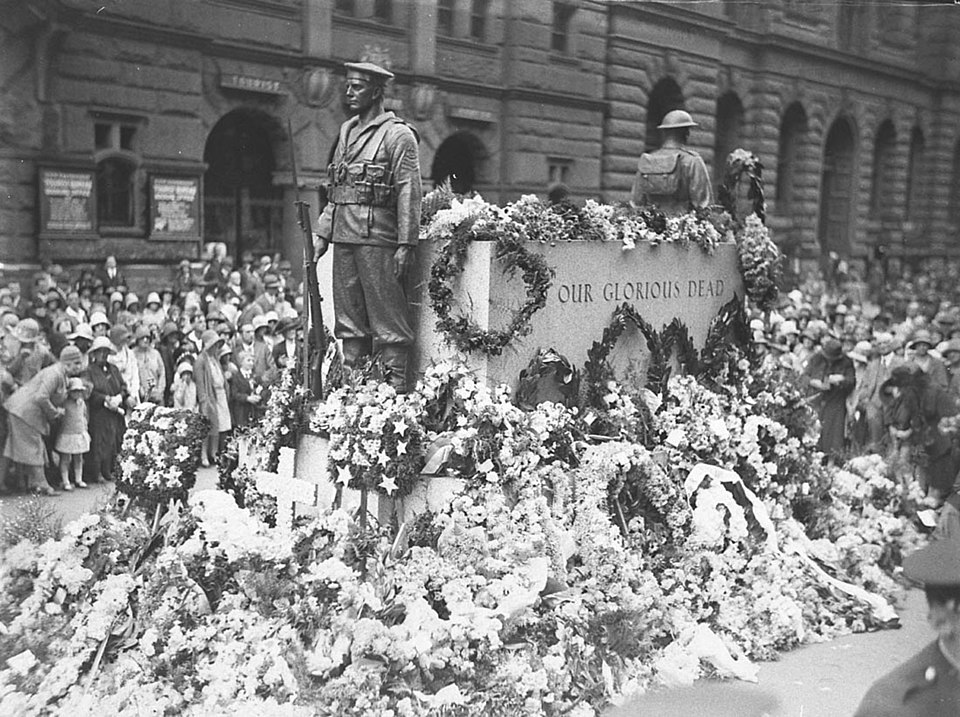
Wreaths on the Cenotaph, Martin Palce, Sydney, Anzac Day, 25 April 1930. Photo: Sam Hood (State Library of New South Wales)
In several places around Australia and in pride of place at the National War Memorial Main Entrance is the statue of Simpson and his Donkey. It was the first statue to honour an individual on the grounds of the Australian War Memorial.
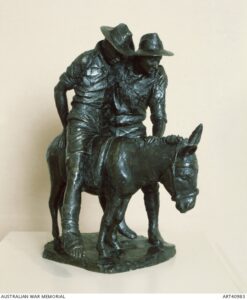
A picture Peter Corlett’s Simpson and his donkey, 1915 (maquette), 1986, courtesy of the Australian War Memorial, ART40983.
Simpson was a stretcher bearer at Gallipoli. After landing on 25 April, he began using one of the donkeys, brought in for carrying water, to transport wounded men day and night from the fighting to the beach on Anzac Cove through what the official historian describes as ‘deadly sniping down the valley and the most furious shrapnel fire’. He was killed by machine-gun fire while carrying two wounded men and was buried on the beach at Hell Spit.
Simpson wasn’t a great warrior who won battle after battle, he was an ordinary guy delivering water and bringing back the wounded. He was just doing his job bravely.
Like Simpson, we don’t have to be super clever or highly trained to do our work for the Lord. We are clay jars – ordinary everyday vessels with a brilliant treasure inside. Christians are workers, labourers, in the harvest field (Matt 9:35-38). The Greek word used for us as Christian labourers, ergates, has connotations of manual labouring. Labourers work up a sweat, get tired and have aching muscles. It doesn’t take a lot of training to be able to pick zucchinis or oranges, as I did on farms as a child.
Labourers are involved with the sheep on the sheep’s terms. They are involved up to their necks with people. Yes, labourers will rightly handle the word of truth (2 Tim 2:15). Anyone who handles God’s word — especially those entrusted with teaching — must do so with disciplined care, accuracy and a desire for God’s approval. But this doesn’t mean labourers have to be experts in the original languages or know them. It means labourers need to keep straight the basics of the gospel that we talk to people about.
On Anzac Day, as we remember those who paid with their life, those who were significantly damaged by their service and those still serving today, thank God for the one who paid the ultimate sacrifice: Jesus, who died in our place and rose again, as we remembered so recently at Easter.
Featured image of poppies on the wall of a memorial by Troy Mortier, Unsplash.